Veinal necrosis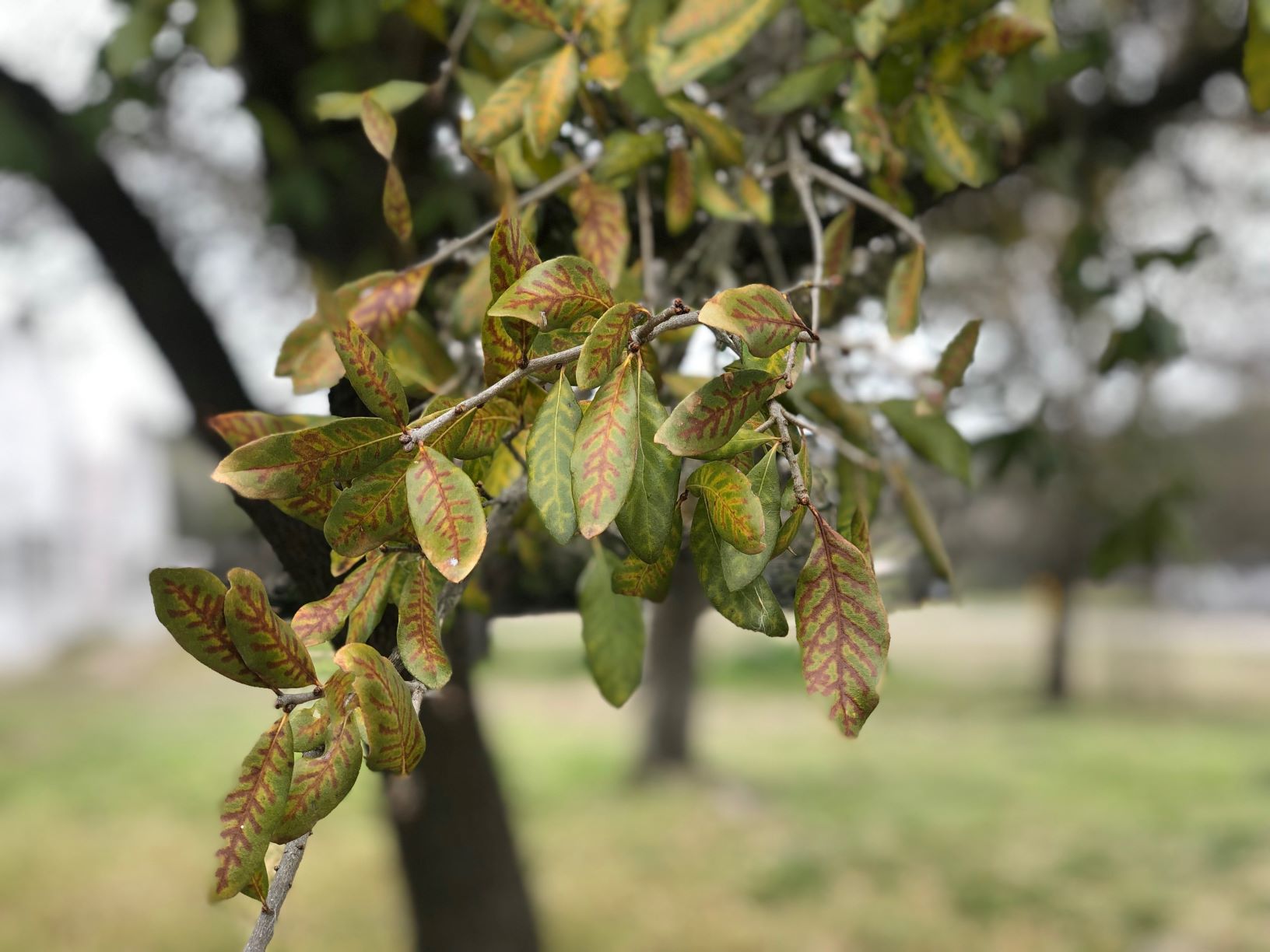
Leaf veins yellowing, then browning
On live oaks, the tell is veinal necrosis: the veins turn yellow then brown while patches of the leaf stay green. The browning tracks the veins.
Austin & the Hill Country / TOWQ-685
If your live oaks are browning out of season, you may have weeks, not months, before it spreads to the rest of your yard. Get a Texas Oak Wilt Qualified arborist on site, fast.
(01) If you suspect it
Most oak wilt damage is made worse by a well-meaning but wrong first move. If you think you have it, start here.
Removing or pruning a suspected oak wilt tree at the wrong time can speed the spread. Leave it standing until it is assessed.
Any new cut or wound on any oak gets wound paint immediately, within minutes, year round. An open cut is an invitation.
Do not haul off or store unsealed oak wood. Red oak firewood can carry live spore mats to a new property.
Call a Texas Oak Wilt Qualified arborist. The sooner it is confirmed, the more of the surrounding oaks can be saved.
(02) What it looks like
These patterns point toward oak wilt, but they overlap with other problems. Only lab testing confirms it. If you see them, the next move is an assessment, not a chainsaw.
On live oaks, the tell is veinal necrosis: the veins turn yellow then brown while patches of the leaf stay green. The browning tracks the veins.
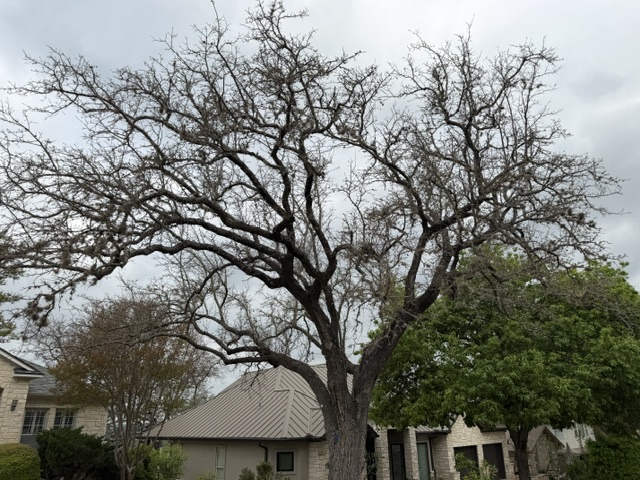
Rapid browning and leaf drop in spring or summer, when the tree should be at its fullest, is a red flag worth looking at this week, not next month.
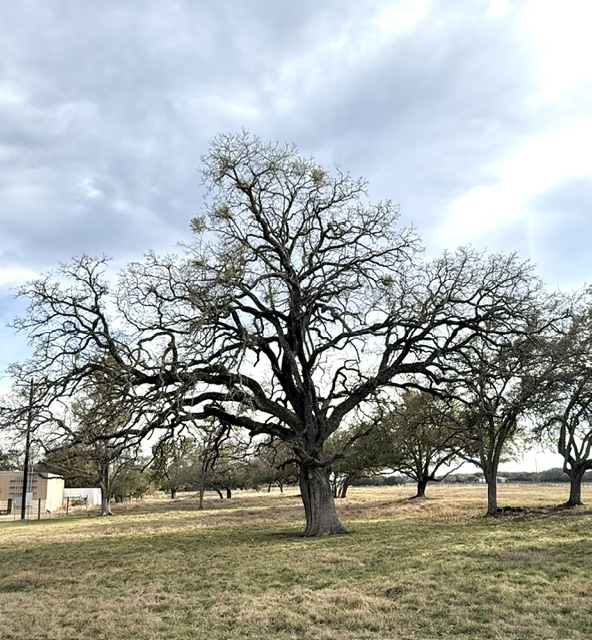
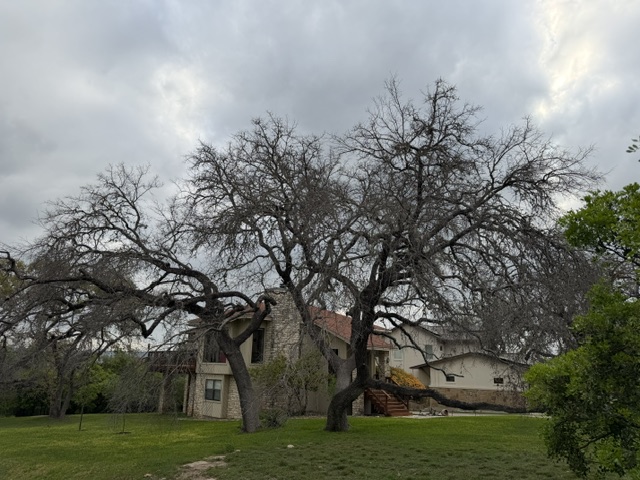
One oak failing, then the next one over, in a slowly expanding circle. That ground-level pattern is the signature of root-to-root spread between connected live oaks.
Photos are from real Central Texas sites. The symptoms shown are consistent with oak wilt. They are not a diagnosis. Confirmation requires an on-site evaluation and laboratory testing.
(03) How we stop it
As a Texas Oak Wilt Qualified arborist, here is how a suspected or confirmed Austin infection center gets handled.
A qualified read of the tree, the site, and the pattern of decline, usually within the same week.
Samples submitted for testing, because oak wilt is reportable and worth confirming before you spend on treatment.
A deep trench placed well beyond the symptomatic trees, severing grafted roots to stop the underground spread.
Propiconazole to protect high-value live oaks. It guards the tree but does not stop root spread on its own.
Safe removal and proper handling of infected red oaks so they cannot seed a new center down the street.
(04) Where we work
Oak wilt centers run heavy through the live oak neighborhoods west of town and out along the lakes. On-site assessment and a containment plan, wherever your oaks are.
Don't see your area? Call anyway. If it has oaks and it's near Austin, it's likely on the route.
(05) Why it matters who you call
TOWQ-685 and ISA Certified Arborist TX-5089A. Oak wilt management is a specific qualification, not something every tree crew carries. The right diagnosis up front saves trees and money.
Because oak wilt is reportable in Texas, a suspected case is verified through certified diagnostics and routed appropriately before any treatment or removal. No guessing, no chainsaw-first.
(06) Straight answers
Do not cut, prune, or remove the tree yet, and do not let anyone else. Paint over any fresh wounds immediately, keep any cut wood on site and covered, and get a Texas Oak Wilt Qualified arborist out to confirm it before the fungus reaches your other oaks. The wrong cut at the wrong time makes it worse.
Red oaks can be dead within weeks once symptoms appear. Live oaks usually decline over three to six months, but because Austin live oaks share root systems, an infected tree pulls its neighbors down with it, so the yard-level clock is shorter than any single tree suggests.
Often, if you move quickly. A deep trench can sever the shared roots that carry the fungus underground and stop it from spreading, and high-value live oaks can be protected with propiconazole injection. Confirmation and a containment plan come first, because oak wilt is a reportable Texas disease.
(07) Get an assessment
The sooner it is confirmed, the more trees can be saved. Send what you are seeing and you will get a straight answer on whether it needs an urgent, on-site look.
This page is educational and does not diagnose, treat, or certify any tree. Oak wilt is a reportable disease in Texas. A suspected case must be evaluated on site by a qualified arborist and confirmed through certified laboratory diagnostics, and reported to the Texas Plant Disease Diagnostic Lab where applicable, before treatment or removal decisions are made.